 Skip to content

How to Make Your Chili Harvest Last All Year
At TNT Peppers, we like to say that peppers are too good to waste. Whether you’re a die-hard chilihead or just starting to explore the

Today’s a rainy day here on the farm. It is a light drizzle, which is fine for working, but every 15 minutes or so it becomes a dense wall of k@k working conditions. Like fishing in the rain on the ocean. There’s nowhere to go except inside and here we are.
The weather thankfully affords me the opportunity (and time) to put a few words down for all you heat-seeking pepper heads. If you ever thought of expanding your growing operation, starting off with your first pepper plants or simply just have a kink for spicy food, stay tuned for this week’s blog.
There are few things that come close to being as rewarding as growing peppers. I can think of maybe one or two right now, but that’s another story for another time when the kids and grandparents have gone to bed. Or perhaps somewhere around a fire, deep in the Kalahari somewhere. Where only the jackal eavesdrops and cowers and shudders, and the hyena stops laughing at what they have just heard. Back to growing peppers, yes?
What’s amazing about growing peppers is the countless varieties, shapes, tastes, traits and most importantly – the levels of burn or “spiciness” as some folks say. These plants amaze me every day with the amount of fruit they produce, and the sheer jaw-dropping shapes, varieties and colours.
I think every person’s journey is different. Mine started by naturally having a thing for plants and understanding logical and natural systems and eventually getting gatvol (tired of it) of city life and revitalising the family farm. When I lived in Johannesburg, I turned large parts of my meagre garden into a food patch which was always a great talking point around the braai for most people, not to mention a free source of produce, and hopefully an inspiration for some.
Starting a pepper farm is an exciting journey that requires careful planning, learning from experience, and embracing the challenges along the way. You must be able to deal with disappointment and remember not to be too hard on yourself. Whether you’re growing for personal use or aiming for commercial success, these foundational steps will give you an idea and understanding of what it takes to scale from your stoep to a patch of land, maybe even a fully-fledged greenhouse.

From my brief experience in farming – being it peppers or broccoli, these fundamentals seem to remain the same, and they are listed here in no particular order. Except perhaps the last point which deals with scaling.
1. Selecting the Right Seeds – Let’s say you wake up one morning and say, “I’m growing peppers today”. A Good place to start is by reckoning what you want to grow hey. Do you want to grow super-hot varieties, or something more in the medium to hot range? These are important questions you, yourself and your pepper head-self should ask. Once the inner monologue has reached an accord, the time has come to quest for genetics.
The first step in growing peppers is choosing the right variety. Different peppers have unique heat levels, flavours, and growing requirements.
2. Climate Adaptability – Choose varieties suited to your region’s weather conditions. You can try to put them in your small greenhouse for over-wintering, try lighting solutions to trick the plant its still summer. All these are venerable quests are doomed to fail. Peppers are seasonal. There are very few varieties that can hold up in winters here, unless you are somewhere with a warmer winter climate, there may be a snowball’s chance in hell. But it comes down to light then – That’s a rabbit hole on its own.
3. Market demand / Reasons why you are growing – If you plan to sell your peppers, research which types are most in demand, and if you are purely passionate about peppers. Consider things like:

At TNT Peppers we grow peppers because we want to bring you the most exotic, tasty, spicy weapons of mouth destruction, so that you can invent that epic braai sauce to blow your mates tastebuds away with or create that chutney that makes your pale and gaunt aunty blush again. That’s what drives us, and our philosophy keeps us true to you – the crazy beautiful pepper heads. You know you are.
You can checkout our store here. Oh, and this month a competition is on the way if you can guess the number of peppers in the bag, you can win a year’s supply of weapons of mouth destruction. Yeah baby! Back to the blog.
4. Understanding Soil and Growing Conditions / Understanding Hydroponic Farming and Plant Biology – To grow the pepper, you must become the pepper. Starship Troopers reference there. Trust me, watch it. In any event it is most crucial to understand the biology of the pepper plant. I’m not saying you must go sign up at a university and waste money on courses and PHD’s. A good first step is to simply Google “Pepper plant Biology – how to grow amazing peppers”. You can thank me later. From there you can understand basic plant biology like nutrients, life cycles, enemies, friends and frenemies. That sort of thing.
Soil quality plays a crucial role in the success of your pepper endeavour. Most peppers prefer a slightly acidic to neutral pH (6.0-6.8) and well-draining soil rich in organic matter. If your soil lacks key nutrients, amend it with compost, manure, or organic fertilizers. Or simply build your own soil for potting at home. Use good quality compost, natural plant material and fibres, some good old dirt and mix it all together. You can use 1 part plant material, 3 parts compost, 1 part dirt (from the garden). This should get you going. I also put a bit of gravel at the bottom of potted plants to assist in drainage. Mix in some good organic fertiliser pellets too in your mix. That should be a good start.
If you decide to go hydroponic, understand this: It is not easy. The rewards are amazing, but it can be extremely tricky for a variety of reasons. It is also quite expensive – both from a resource perspective (electricity and space) and a nutrient and fertilizer perspective. You also must consider all the kit.
My ideal setup I would imagine would be a deep-water culture or Dutch bucket setup. Hydroponics enables amazing root growth and formation which leads to gorgeous looking plants. I would mainly keep an eye on contaminants (that means anything – bugs, debris, sand / ground, insects, anything) getting in the water buckets and water PH and EC (Electrical Conductivity). Understanding the balance between these two is vital to the success of your plant. If you get it wrong, you will pay in the form of mass die offs.
If you are starting out, I recommend doing it in compost soil mixture. If you have grown hydroponically before, go for it. If we get some feedback on growing hydroponically from you all, I will do a deep dive in to that for you.

5. Starting Small and Expanding Gradually – It’s tempting to go balls to the wall from the start, but beginning with a manageable number of plants and area allows you to fine-tune your methods.
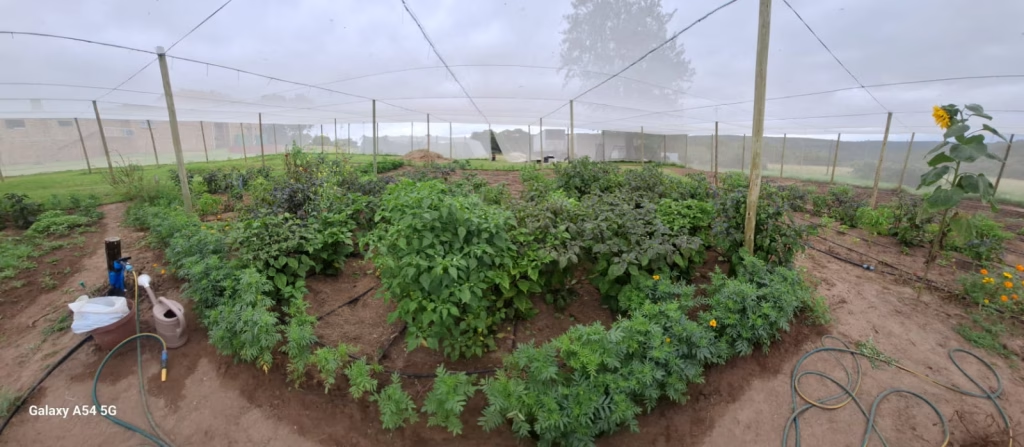
Start with a small backyard section, learn what works best for your conditions, and then scale up to larger spaces or greenhouses as your experience grows. I must say having a nethouse takes care a lot of my anxiety. It helps with extreme weather, pests and affords the plants a place they can grow. Also never forget to get your spouse’s permission or buy-in. Growing peppers can become obsessive, and ja, somewhere the obsession must make peace with compromise. But having said that I’m not Uncle Phil, this is not American TV, and I’m single so…back to the peppers.
6. Building a Local Support System – Growing peppers is very much a community affair. Soon when you get into this, the rabbit hole is deep, and the community is very helpful. I am old, so I still checkout Reddit. It’s a gold mine.
If you are farming, it is not a solo endeavour. Connect with local farmers, other growers, and online communities for advice and support. Joining a farming network can help you access valuable insights on pest control, disease management, and best practices. Use the internet. It is also good for learning new things, not just streaming YouTube or Netlix and chill.
7. Learning from Mistakes and Adapting – Not every season will be perfect, and challenges like pests, weather fluctuations, and plant diseases are inevitable. Try to keep detailed records of what works and what doesn’t, adjust your strategies accordingly, and stay resilient. Don’t be hard on yourself. Forgive yourself and keep on trucking.
8. Seeking Guidance and Staying Humble – Even experienced farmers continue to learn. Attend workshops, watch educational videos, and seek mentorship from those who have already built successful pepper farms. Being open to new techniques and feedback can accelerate your growth. I learnt everything I know about farming and peppers from friends, fellow farmers and the internet. Also staying humble is a far greater mindset to learn from, than that of the other side of the humble coin.

9. Transitioning to a Greenhouse / Nethouse Setup / Scaling your Dreams – Once you’ve mastered outdoor growing, expanding into a controlled environment like a greenhouse can boost your yields and provide protection from harsh weather. A greenhouse offers:
Our personal preference at TNT Peppers is the organic nethouse approach. From a costing perspective, a nethouse is far more viable than the outlay of a proper greenhouse. Temperature and conditions are regulated naturally. We stay clear of pesticides and chemicals and adopt and a regenerative and closed-loop approach to our operation. Meaning all the plants requirements are met by producing soil and fertiliser on the farm. Some advantages of a nethouse:
At the end of the day, if you have not mastered the basics of growing peppers, and you scale, you will experience all the little problems of peppers at scale. I cannot stress that enough – get the basics right first before you consider scaling. I get anxiety thinking about one plant being getting sick, Lord forbids an entire greenhouse. Know what I’m saying eager pepper padawan? Get the basics right.

Final Thoughts
Starting a pepper farm is a journey of patience, learning, and passion. By taking the time to understand your soil, building a strong foundation, and seeking support from experienced growers, you can transform a small backyard project into a full-fledged greenhouse operation.
Stay committed, keep experimenting, and enjoy the rewards of growing your own peppers. Never give up. Think of each mistake as a learning experience, stay humble and “kap aan” or carry on as they in these parts. Ja swaer. Net so.
I would love to hear your stories. You can continue to hear ours by following on us on Facebook by like and sharing our posts. Until the next blog, may the force be with you, and your peppers.
Mark F
Grower, TNT Peppers


At TNT Peppers, we like to say that peppers are too good to waste. Whether you’re a die-hard chilihead or just starting to explore the

Why Fermenting Your Peppers at Home is a Game Change If you’ve ever enjoyed a tangy, complex hot sauce or a chili with a deep,